Solar Panels vs Wind Turbines for Homes
Ready to see what solar could save you?
Get free, no-obligation quotes from MCS-certified installers in your area.
Get Free QuotesFree, no obligation. Takes 2 minutes.
Are solar panels or wind turbines better for homes?
For UK residential use, solar panels are significantly better than domestic wind turbines. Solar is cheaper (£5,500–£8,000 vs £15,000–£30,000), more reliable (consistent output vs highly variable wind), requires no planning permission (vs almost always needed for turbines), has no moving parts (vs maintenance-heavy turbines), produces no noise (vs turbine noise complaints), and delivers better ROI (8–12 year payback vs 15–25+ for domestic wind). The only scenario where a wind turbine competes is on very exposed rural sites with consistent high wind — and even there, solar is usually a better starting point.
Solar vs Wind: Full Comparison
| Feature | Solar Panels (4kW) | Domestic Wind Turbine (5kW) |
|---|---|---|
| Cost | £5,500–£8,000 | £15,000–£30,000 |
| Annual output | 3,800–4,200 kWh | 2,000–9,000 kWh (highly variable) |
| Payback | 8–12 years | 15–25+ years |
| Planning permission | Usually not needed | Almost always required |
| Noise | Silent | 30–50 dB (complaints common) |
| Maintenance | Almost none | Annual servicing, moving parts |
| Lifespan | 25–30 years | 15–20 years |
| Reliability | Very consistent (sunlight data) | Highly variable (wind dependent) |
| Visual impact | Moderate (on roof) | High (tall mast, visible for miles) |
| Neighbours | No issues | Complaints common (noise, visual) |
| MCS certification | Widely available | Limited installers |
| DIY potential | Not recommended but possible | Dangerous without expertise |
| Verdict | Clear winner for most homes | Niche rural applications only |
Source: Energy Saving Trust technology comparison; MCS installation statistics.
Why Domestic Wind Turbines Underperform
The problem with domestic wind:
1. Turbulent urban/suburban wind: Buildings, trees, and terrain create turbulent airflow. Turbines need smooth, consistent wind above 5m/s (11mph) to generate effectively. Most UK suburban sites have average wind speeds of 3–4m/s — below the productive threshold.
2. Mast height limitations: Effective wind turbines need 15–25m masts (above surrounding obstacles). Planning permission for such masts is routinely refused in residential areas.
3. Low output vs prediction: Many domestic turbine installations produce 10–30% of their predicted output because site wind speeds are overestimated. Solar predictions, by contrast, are highly accurate (decades of irradiance data).
4. Moving parts = maintenance: Turbines have bearings, blades, yaw mechanisms, and generators — all subject to wear. Annual servicing costs £200–£500. Solar has zero moving parts.
5. Noise: Even 'quiet' turbines produce 30–50 dB at close range. In residential settings, this causes neighbour complaints and can lead to enforcement notices.
6. Short lifespan: Domestic turbines last 15–20 years with proper maintenance. After 15 years of marginal ROI, you face replacement rather than continued saving.
The honest assessment: Domestic wind turbines are one of the most disappointing renewable technologies for residential use. They rarely deliver the predicted output or financial return. Solar is the clear choice.
Source: Energy Saving Trust domestic wind performance review; Renewable UK consumer data.
Ready to see what solar could save you?
Get free, no-obligation quotes from MCS-certified installers in your area.
Get Free QuotesWhen a Wind Turbine MIGHT Make Sense
Very few situations favour a domestic wind turbine:
- Exposed rural hilltop — consistent wind above 5m/s average, no nearby obstacles
- Remote off-grid property — wind complements solar (wind is strong in winter when solar is weak)
- Very large land area — room for a tall mast far from neighbours and buildings
- Already have maximum solar — and want additional renewable generation (rare scenario)
- Island or coastal location — consistently high wind speeds with minimal turbulence
Even in these ideal scenarios, install solar FIRST. Solar delivers guaranteed, predictable returns. Wind is a supplement, not a primary generation source for homes. If you have budget for both: 80% solar + 20% wind gives the best year-round coverage.
Source: Renewable energy consultancy site assessment data.
The Best Home Renewable Investment in 2026
For the vast majority of UK homeowners, the optimal renewable investment is:
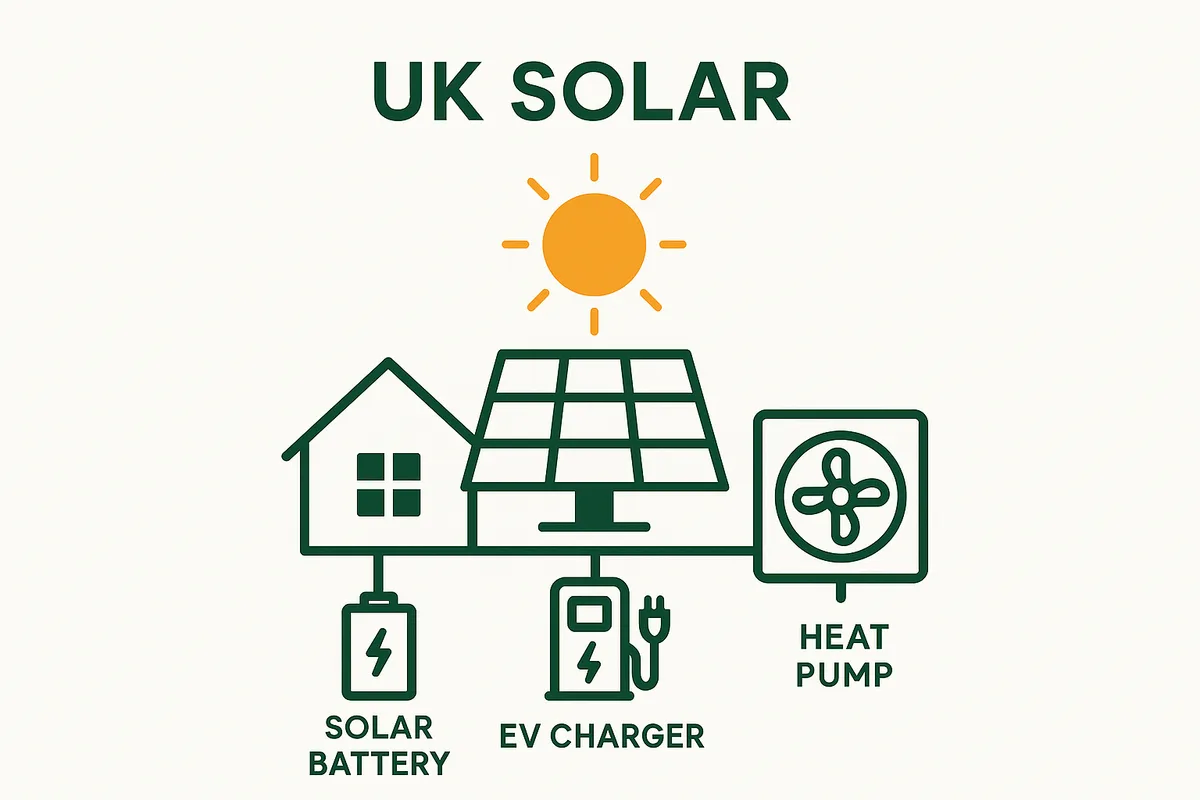
1. Solar panels — the foundation (4–6kW, £5,500–£11,000) 2. Solar battery — stores solar for evening (10kWh, £4,000–£6,000) 3. Smart tariff — maximises value (Octopus Flux/Go, free to switch) 4. Solar diverter — free hot water (iBoost+/Eddi, £200–£400) 5. EV charger — free transport (Zappi, £800–£1,100) 6. Heat pump — replace gas heating (£3,500 after BUS grant)
This stack delivers £1,500–£2,500/year in total savings. A domestic wind turbine does not fit into this stack — solar is the clear foundation.
Source: Home energy optimisation modelling.
Frequently Asked Questions
Related guides
You might also like

Ready to see what solar could save you?
Get free, no-obligation quotes from MCS-certified installers in your area.
Get Free QuotesFree, no obligation. Takes 2 minutes.