Solar Panel Carbon Footprint: The Full Picture
What would this actually cost at your home?
Installed prices vary widely by roof, access and region. Get an installed price for your property from MCS-certified installers.
Get an Installed PriceFree, no obligation. Takes about 2 minutes.
What is the carbon footprint of solar panels?
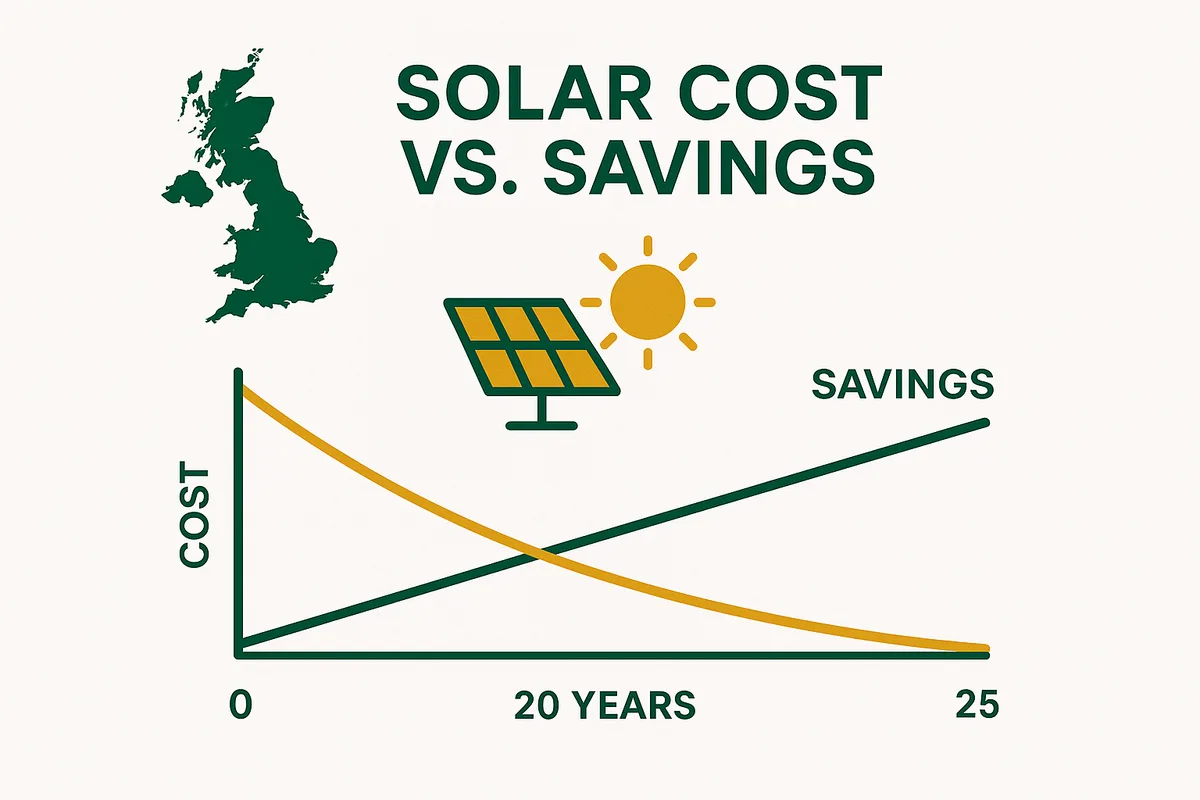
Manufacturing a solar panel creates approximately 400–500 kg of CO2. But a UK panel offsets approximately 150 kg of CO2 per year by displacing grid electricity. The carbon payback is 2.5–3.5 years. Over 25 years, a typical 4kW system prevents 35–50 tonnes of CO2 emissions — equivalent to planting approximately 1,600 trees or driving 100,000 fewer miles in a petrol car.
Manufacturing Carbon Footprint
Making a solar panel requires energy-intensive processes:
Key manufacturing steps and their carbon cost: - Silicon purification and wafer production: 250–350 kg CO2/panel - Cell processing and metallisation: 50–80 kg CO2/panel - Module assembly (glass, EVA, backsheet, frame): 40–60 kg CO2/panel - Transport (typically from China to UK): 20–30 kg CO2/panel
Total per panel: ~400–500 kg CO2 Total for a 4kW system (10 panels): ~4,000–5,000 kg CO2 (4–5 tonnes)
Context: 4–5 tonnes of CO2 is equivalent to: - Driving a petrol car 12,000–15,000 miles - One return economy flight London–New York - 6 months of average UK household energy use
Important: This footprint is a one-time manufacturing cost. Once installed, the panel generates zero-carbon electricity for 25+ years.
Source: IRENA lifecycle assessment 2023; Fraunhofer ISE environmental impact data.
Carbon Payback: How Fast It Is Repaid
Every kWh of solar electricity displaces a kWh of grid electricity. The UK grid in 2026 produces approximately 150–200g of CO2 per kWh (this has fallen dramatically as coal and gas generation decrease).
Carbon payback calculation for a 4kW system: - Manufacturing footprint: 4,500 kg CO2 (4.5 tonnes) - Annual CO2 avoided: 4,000 kWh × 180g = 720 kg CO2 (0.72 tonnes) - Carbon payback: 4,500 ÷ 720 = ~6.3 years (at current grid carbon intensity)
But the grid is getting greener: As the UK grid decarbonises further, the CO2 avoided per kWh decreases. However, the initial manufacturing footprint is also falling as manufacturing shifts to renewable energy.
Historical context: - 2010 grid carbon: 500g CO2/kWh → carbon payback: ~2 years - 2020 grid carbon: 230g CO2/kWh → carbon payback: ~3 years - 2026 grid carbon: 180g CO2/kWh → carbon payback: ~4 years - 2035 grid carbon: ~50g CO2/kWh (target) → panels still worthwhile as manufacturing footprint also falls
The bottom line: Solar panels repay their manufacturing carbon within 3–6 years, then generate 20+ years of genuinely carbon-free electricity.
Source: BEIS UK grid carbon intensity data; National Grid ESO carbon tracking.
What would this actually cost at your home?
Installed prices vary widely by roof, access and region. Get an installed price for your property from MCS-certified installers.
Get an Installed Price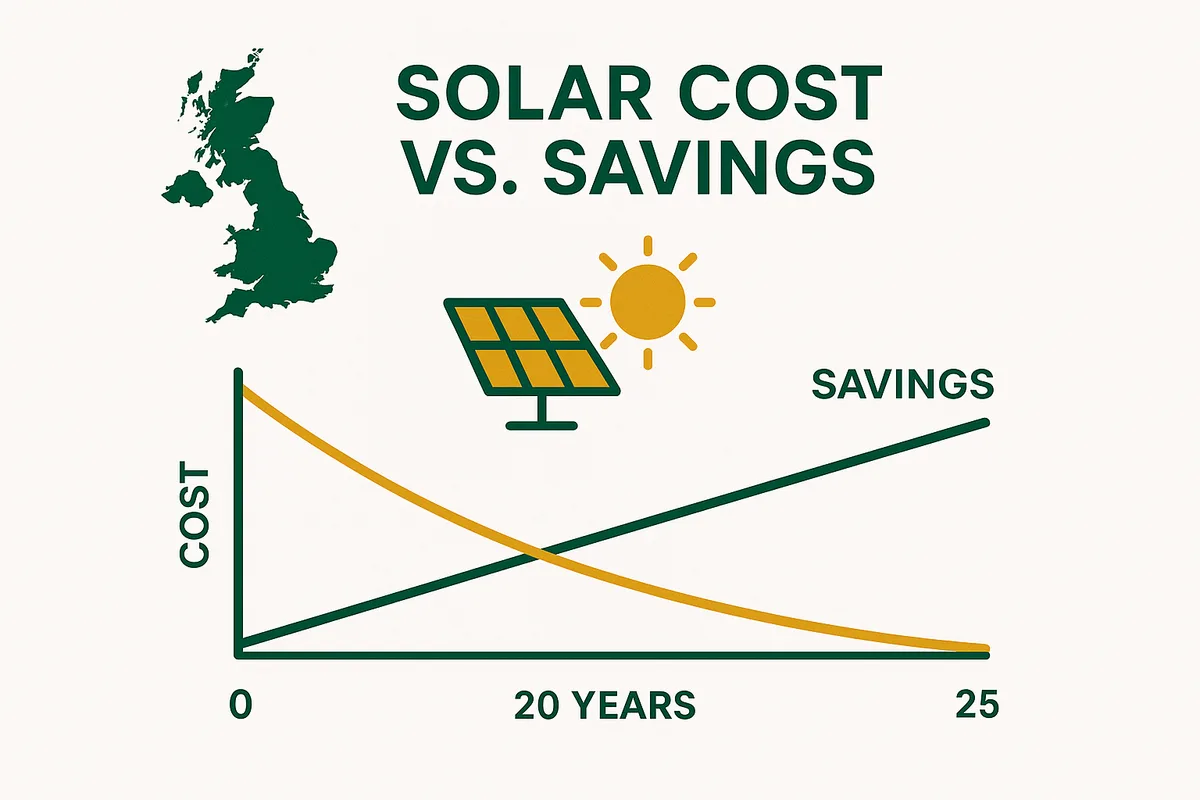
25-Year Carbon Savings
Over 25 years, a 4kW system's net carbon impact:
Manufacturing footprint: –4.5 tonnes CO2 25 years of generation: +18 tonnes CO2 avoided (at declining grid carbon intensity) Net carbon benefit: +13.5 tonnes CO2 prevented
But using the 2026 grid carbon intensity throughout (conservative): - 25 years × 4,000 kWh/year × 180g/kWh = 18,000 kg = 18 tonnes CO2 avoided - Minus manufacturing: 4.5 tonnes - Net: 13.5 tonnes CO2 saved
Equivalent to: - Planting approximately 600 trees - Not driving 35,000 miles in a petrol car - 3 years of average UK household total energy use
If the grid is dirtier than expected (more gas usage), solar saves even more CO2. If the grid is cleaner, the savings are smaller but solar still provides value through electricity bill reduction.
Source: Carbon Trust UK; BEIS greenhouse gas reporting factors.
How Solar Compares to Other Green Actions
Annual CO2 savings comparison:
| Action | Annual CO2 Saving | Upfront Cost |
|---|---|---|
| 4kW solar panels | 720 kg | £6,750 |
| Switch to EV (from petrol) | 1,500 kg | £25,000+ |
| Air source heat pump (from gas) | 1,000 kg | £3,500 (after grant) |
| Go vegan (from average diet) | 600 kg | £0 |
| Insulate loft (270mm) | 300 kg | £400 |
| Switch to green energy tariff | 0 kg (already green) | £0 |
| Plant 10 trees | 250 kg (mature) | £50 |
Solar panels are one of the highest-impact, most tangible actions an individual homeowner can take. They also save money — most other green actions cost money or change your lifestyle.
Source: CCC (Climate Change Committee); Energy Saving Trust carbon data.
Frequently Asked Questions
Related guides
You might also like

What would this actually cost at your home?
Installed prices vary widely by roof, access and region. Get an installed price for your property from MCS-certified installers.
Get an Installed PriceFree, no obligation. Takes about 2 minutes.