Solar Panel Efficiency Explained: What Matters
Ready to see what solar could save you?
Get free, no-obligation quotes from MCS-certified installers in your area.
Get Free QuotesFree, no obligation. Takes 2 minutes.
What does solar panel efficiency mean?
Solar panel efficiency is the percentage of sunlight hitting the panel that is converted into electricity. Residential panels range from 15% to 23%. A 20% efficient panel converts one-fifth of the sunlight energy into usable electricity. Higher efficiency means more power from less roof space — but the most efficient panels cost more. For most UK homes, 19–21% efficiency panels offer the best balance of performance and value.
Efficiency Ranges by Panel Type
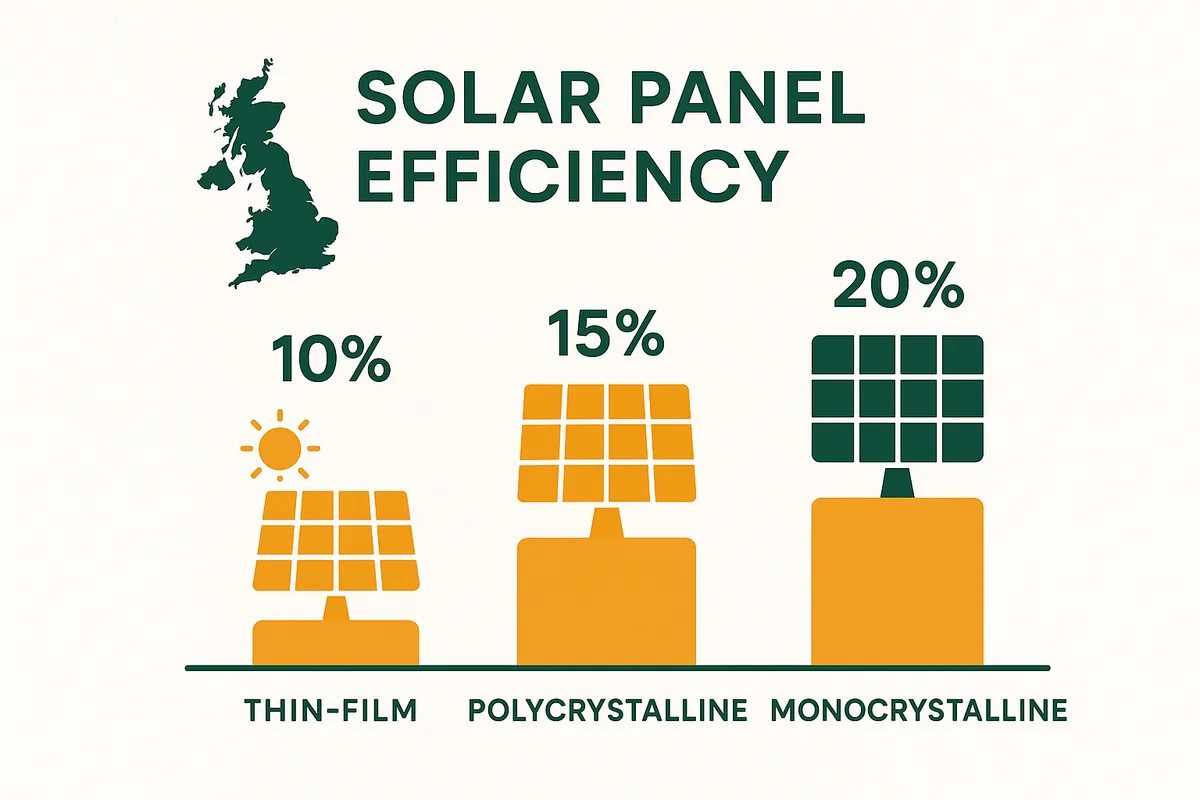
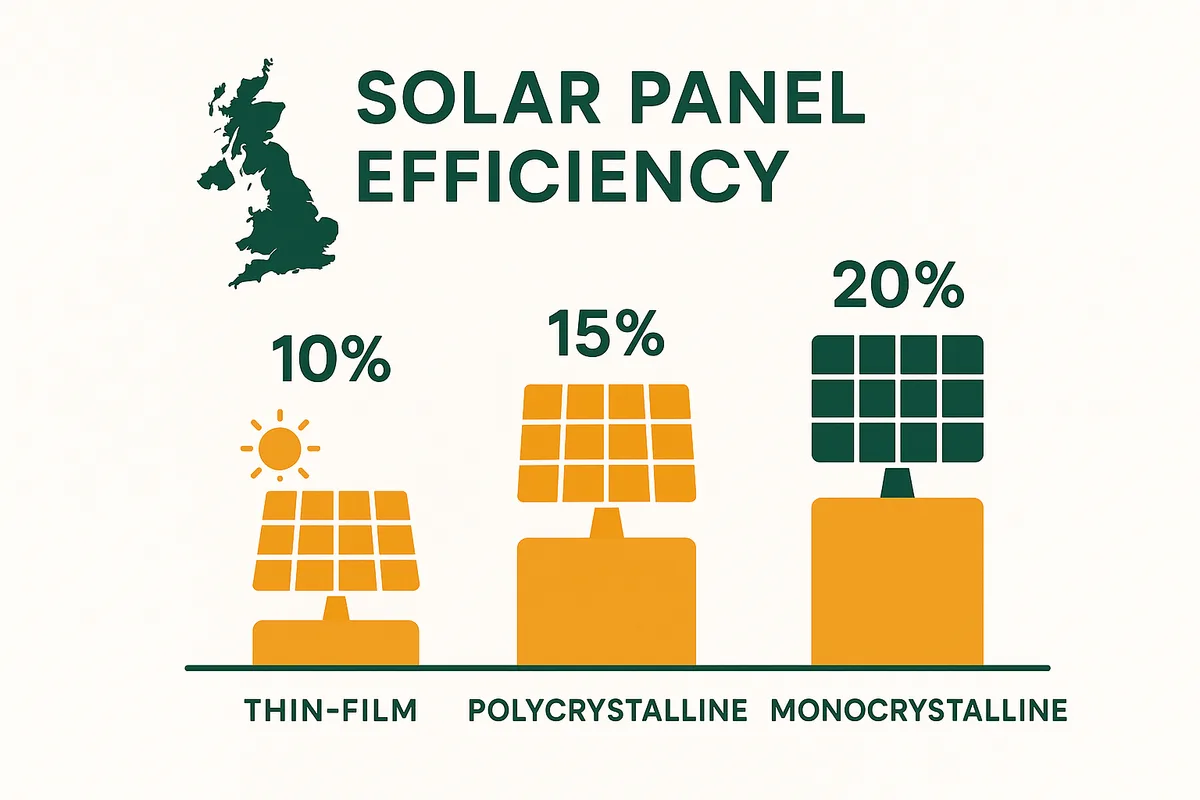
Different panel technologies achieve different efficiencies:
- Monocrystalline: 19–23% — the standard for UK residential installations
- Polycrystalline: 15–17% — older technology, declining in popularity
- Thin-film: 10–13% — specialist use only
- TOPCon/HJT (next-gen mono): 21–24% — emerging premium technology
Record efficiencies (laboratory, not commercial): - Single-junction silicon cell: 26.8% (LONGi, 2024) - Multi-junction concentrator: 47.6% (NREL, 2023)
Commercial panels lag behind lab records because of manufacturing constraints, cost optimisation, and real-world operating conditions. The gap between lab and commercial efficiency has narrowed significantly — today's best commercial panels achieve 22–23%, compared to the 26.8% lab record.
Source: NREL Best Research-Cell Efficiency Chart; manufacturer datasheets.
Why Efficiency Matters (and When It Doesn't)
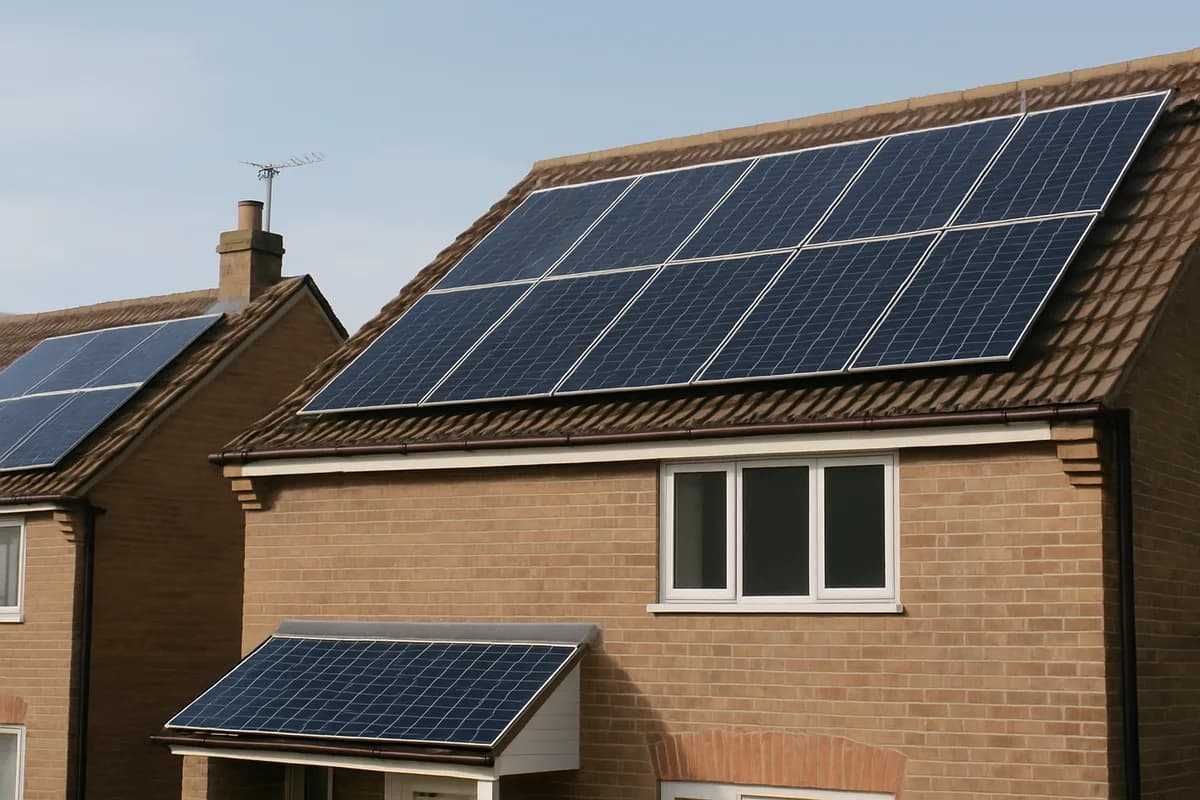
Efficiency matters when: - Your roof space is limited — higher efficiency panels generate more power from fewer panels - You want to maximise total system output — every percentage point adds kWh - You want to future-proof — more efficient panels maintain useful output longer as they degrade
Efficiency matters less when: - You have plenty of roof space — you can simply install more panels to make up for lower efficiency - Budget is tight — a 17% efficient panel costs less than a 22% panel but can be compensated by installing one more panel - The difference is small — 20% vs 21% efficiency makes minimal practical difference
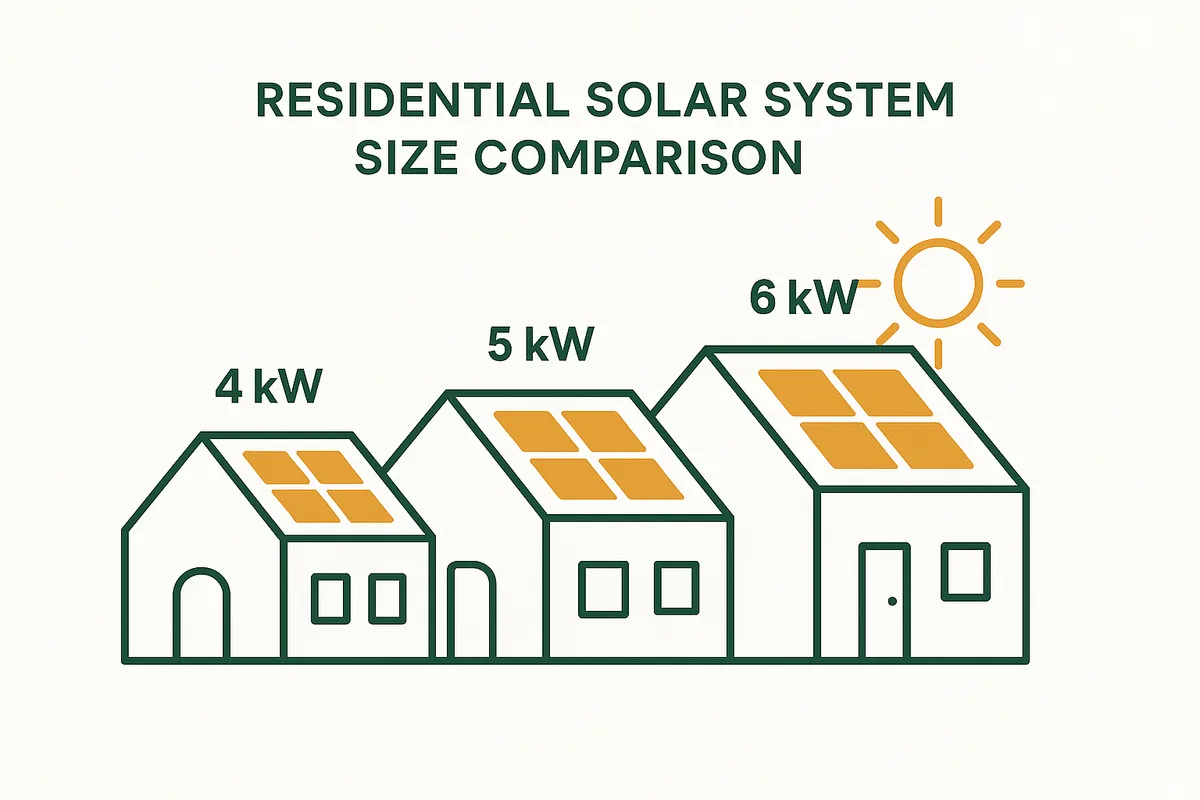
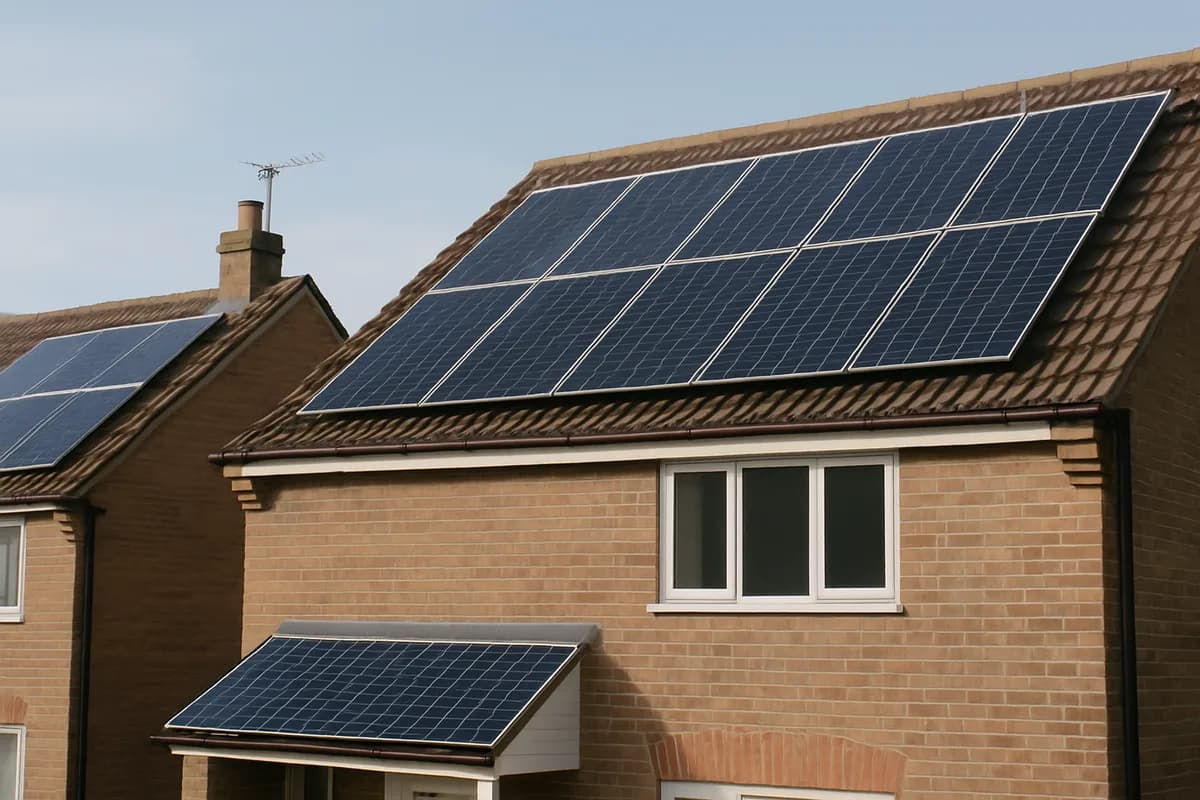
The real-world impact: A 400W panel at 20% efficiency covers approximately 1.7 m². A 400W panel at 22% efficiency covers approximately 1.5 m². For a 10-panel system, the higher-efficiency panels save you about 2 m² of roof space. That is meaningful on a small terraced house but irrelevant on a large detached home.
Source: Panel dimension calculations from manufacturer specifications.
What Reduces Solar Panel Efficiency in Practice?
Ready to see what solar could save you?
Get free, no-obligation quotes from MCS-certified installers in your area.
Get Free QuotesReal-world factors that reduce output below the rated efficiency:
- Temperature — panels lose 0.3–0.5% efficiency per degree above 25°C. UK summers rarely cause significant losses, but a hot July day can reduce output by 5–10% compared to a cool spring day at the same light level.
- Dirt and soiling — dust, bird droppings, pollen, and tree sap can reduce efficiency by 2–10%. Rain cleans most UK panels adequately.
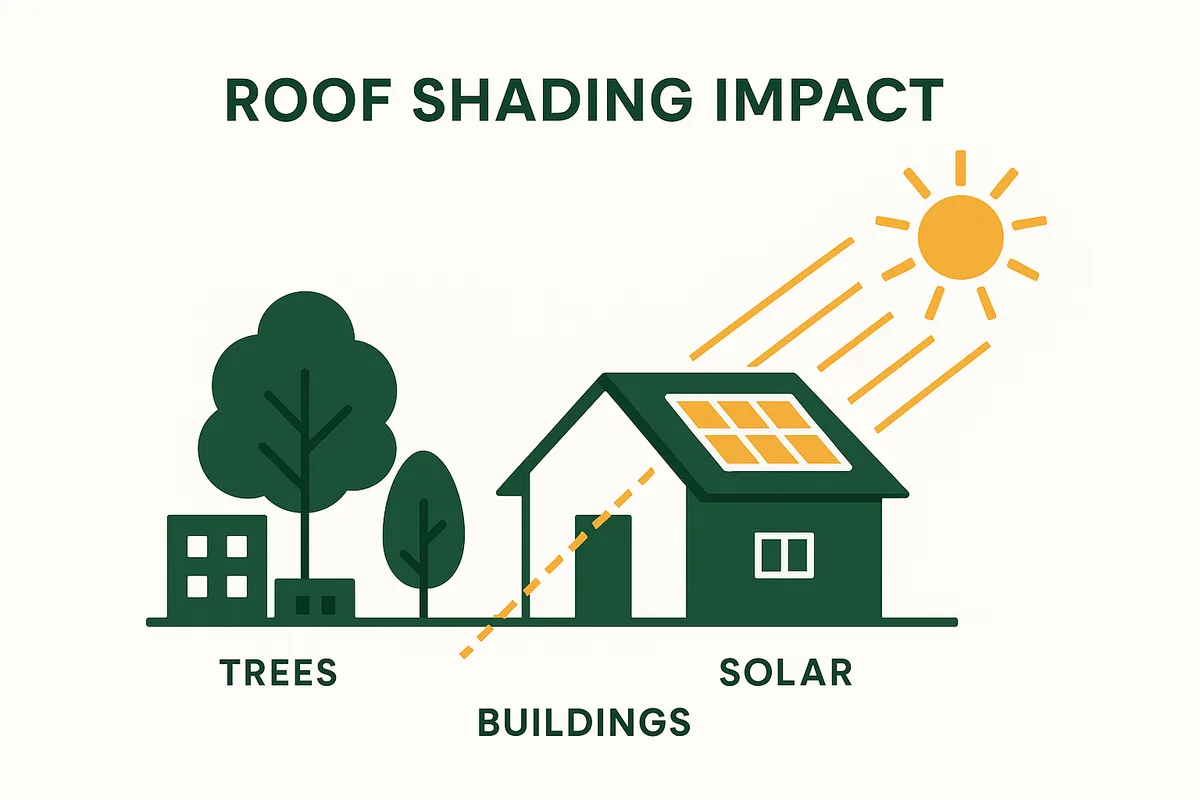
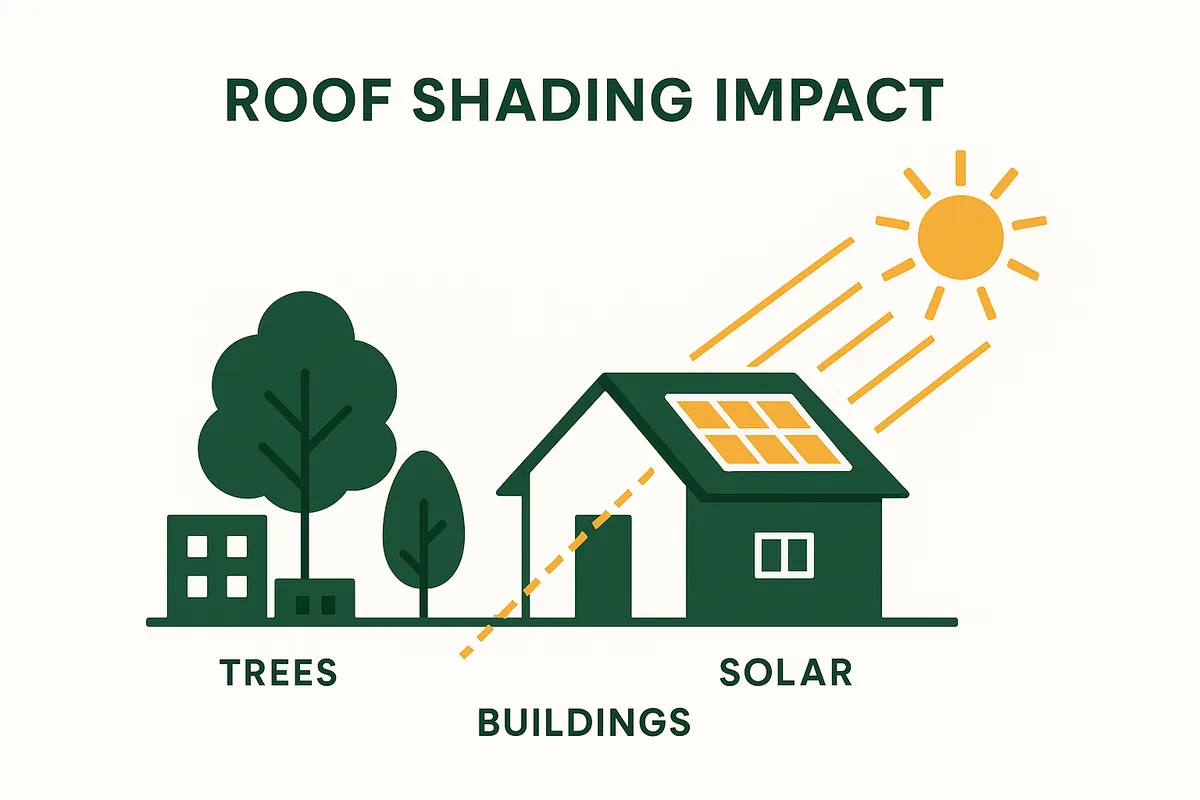
- Shading — even partial shade on one cell can reduce the entire panel's output (with string inverters). Micro-inverters mitigate this.
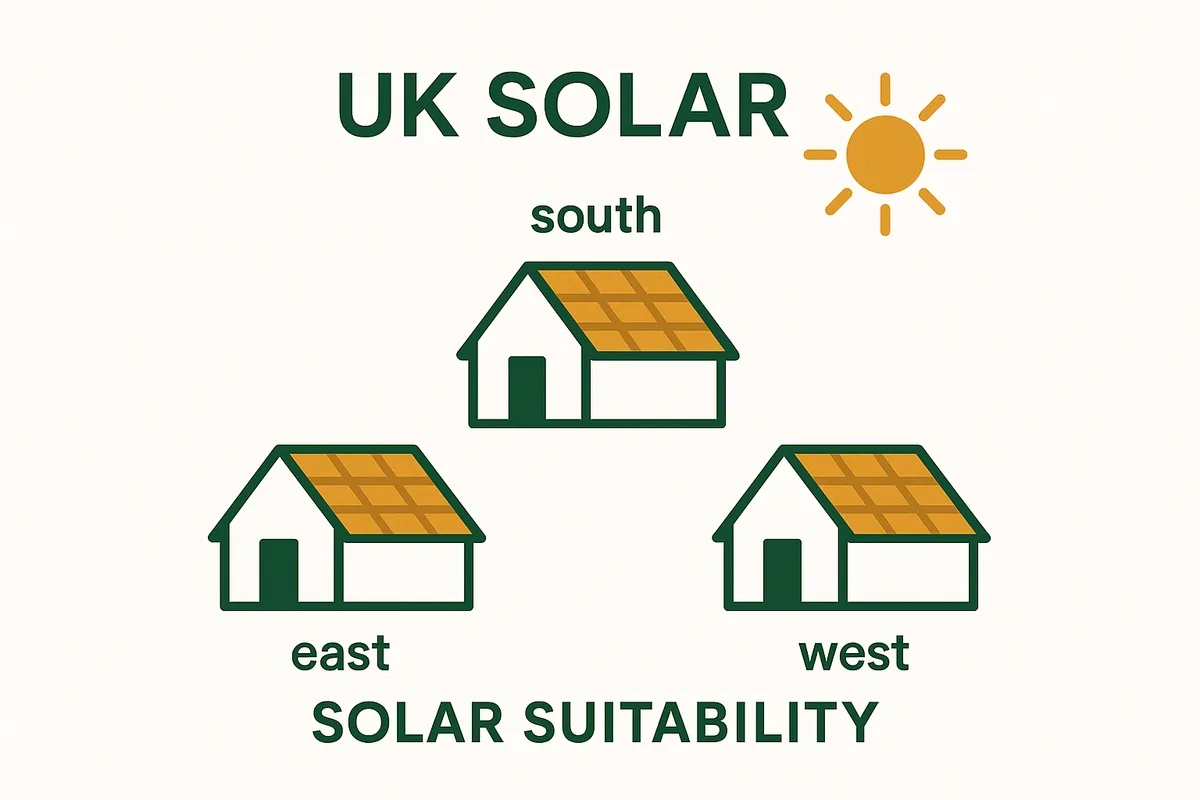
- Roof angle and direction — panels not at the optimal 35° south-facing angle produce less. East/west: 80–85% of optimal. North: 55–60%.
- Age (degradation) — panels lose 0.3–0.5% of output per year. A 20% panel after 25 years effectively operates at ~16–17%.
- Inverter losses — converting DC to AC loses 2–4% of energy. High-quality inverters achieve 97–98% conversion efficiency.
- Cable losses — electrical resistance in cables loses 1–2% of energy between panels and inverter.
Most Efficient Solar Panels Available in the UK (2026)
Top 5 most efficient panels available to UK consumers:
1. SunPower Maxeon 7 — 22.8% efficiency, 440W, 40-year warranty 2. REC Alpha Pure-RX — 22.3% efficiency, 430W, 25-year warranty 3. Canadian Solar HiHero — 22.5% efficiency, 440W, 25-year warranty 4. Longi Hi-MO X6 — 22.0% efficiency, 430W, 25-year warranty 5. JA Solar DeepBlue 4.0 — 21.8% efficiency, 425W, 25-year warranty
Note: The most efficient panel is not always the best value. SunPower panels cost 30–50% more than mainstream alternatives. For most UK homes, panels in the 20–21% efficiency range (JA Solar, Trina, Longi) offer the best value per kWh generated.
Source: Manufacturer datasheets; UK distributor pricing 2026.
Should You Pay More for Higher Efficiency?
Yes, if: your roof space is limited, you want maximum output, or you value the longer warranties that premium panels offer.
No, if: you have ample roof space and want the best value per pound spent. A 20% efficient panel costing £200 generates almost as much as a 22% panel costing £300 — but you can buy 1.5 of the cheaper panels for the price of 1 premium panel.
The practical answer for most UK homeowners: Choose a panel in the 20–21% efficiency range from a reputable manufacturer (JA Solar, Trina, Longi, Canadian Solar). These offer excellent performance at a competitive price. Only go premium (SunPower, REC Alpha) if roof space is genuinely constrained or you want the longest possible warranty.
Do not get distracted by small efficiency differences. The difference between a 20% and 21% panel is roughly 50W per panel — about £10–£15 of electricity per year. Focus on overall system design, inverter choice, and installation quality instead.
Frequently Asked Questions
Related guides
Related: Home Heating Systems
Solar panels are most powerful when combined with an efficient heating system. Heat pumps use solar-generated electricity to heat your home at 300-400% efficiency — making them the ideal partner for solar.
A heat pump converts 1kWh of electricity into 3-4kWh of heat.
From our sister site Home Heat Pump Guide
You might also like
Ready to see what solar could save you?
Get free, no-obligation quotes from MCS-certified installers in your area.
Get Free QuotesFree, no obligation. Takes 2 minutes.